
Salomé Sperling

Lead Creative Webdesigner
September 8, 2026
Summary of the article
- Webflow launched Source on September 2, 2026, in Boston. We are moving beyond "Webflow is a site builder" into "Webflow is a marketing tool." This isn't just an update to what exists; it's a new infrastructure that plugs into any codebase.
- The real problem Source solves isn't building a site with AI—everyone can already do that. It's maintenance: GitHub, hosting, and technical skills. A non-technical marketing team gets lost quickly. Source is a workspace designed for that, not just for building.
- Webflow itself acknowledges that the abstraction layer was the limit: "code is the native language of AI," and it's "a fundamental shift from how Webflow has worked historically."
- Regarding everything else announced at the conference, Webflow is far from a tool that's going away: the current platform will continue to evolve. There are no dates or pricing for Source, and Linda Tong stated on stage that we are still a long way from human-agent collaboration. We have requested preview access. We won't recommend anything until we've tested it.

Summarize with AI
The vision: from a site builder to an agentic marketing tool
Webflow has been talking about an agentic marketing platform for a while. Source is the first time we’ve really seen them commit to this position. We are moving away from "Webflow is a site builder" and into "Webflow is a marketing tool."
Look at how they responded to the market. They didn't just release an update on top of the existing infrastructure. They built a new one that plugs into any codebase.
What this actually solves is a barrier-to-entry problem. Everyone knows how to build a site with AI now. Maintaining it is a different story: managing GitHub repos, hosting, and a handful of things that require real technical skills. A non-technical marketer gets lost quickly. That is the problem Source solves: a workspace designed for non-technical people to collaborate with agents that come with guidelines and limits. Not to build the site. To keep it alive over time.
Stephen Wise, CEO and co-founder of Demandflow, describes the same wall with the stacks he has built himself: no interface for marketers, who end up waiting on engineers who have already moved on to other things. And without real guardrails, agents break things in just a few prompts.
We had already asked the question about the future of agencies in the age of AI after flowConf in Belgrade. The answer is arriving here.
Linda Tong, CEO of Webflow, in the official press release: "the people with the ideas, taste and ambition to build something great are getting entirely new superpowers." The same release points to a specific culprit. AI-assisted coding tools and agentic IDEs give agents direct access to the codebase, which is where their power comes from, but they impose an engineer's workflow: git, branches, and pull requests. In contrast, Source promises governed, code-native workspaces. It changes the guardrails: roles, permissions, and validation paths take the place of branches and code reviews.
Regarding everything else announced at the conference, Webflow—the infrastructure we know—is not disappearing. It continues to evolve, as the rest of the conference clearly showed. But Source is the piece that addresses a real market need, not a feature wishlist.
Key takeaways: Source is not just another feature on Webflow; it is the first real stance on becoming an agentic marketing tool, and it addresses a concrete problem: maintaining a site is harder than building it.
So, what exactly is Source?
A platform where marketing teams and AI agents work together on the code that goes into production. Announced on September 2, 2026, at the annual conference in Boston. Currently in limited research preview, with no release date or pricing yet.
The official tagline is "where marketers and agents run the web".
The product boils down to three things:
- The code that ships becomes the single source of truth, with agents working on it directly while humans retain a visual canvas for final touches.
- The Views provide everyone with an interface tailored to their specific role.
- And agents run continuously, measuring, proposing, and executing within the boundaries you set.
This isn't just an update to the Webflow we know. It is a different product, and Webflow confirms this in their FAQ by referring to it as "our new platform".
Key takeaways: Source is a separate product, not a Webflow update, and its agents work directly on the site's actual code.
Everything announced in Source
| Ce qui a été annoncé | Ce que ça fait | Ce que ça change |
|---|---|---|
| Le code comme socle | Les agents écrivent directement dans le code qui part en production, sans couche d'abstraction | Ils prennent en charge des modifications plus grandes et évaluent leur propre travail |
| Le canvas visuel | Les humains éditent visuellement pour les finitions, chaque modification s'écrivant dans ce même code | Plus de décalage entre ce qu'on édite et ce qui ship |
| Les Views par défaut | Six surfaces de travail livrées : Audit, Agents, CMS, Inbox, Review, Brand | Chacun voit son métier plutôt qu'un accès à tout |
| Les Views custom | Une interface construite autour du process réel d'une équipe | Revendable et installable sur chaque projet, "turn your playbook into a product" |
| Les agents proactifs | Ils surveillent les performances et remontent les opportunités dans une inbox, travail déjà rédigé | Correction AEO, test CRO, page qui décroche : la proposition arrive avant la demande |
| Les agents sur mesure | Des agents cadrés sur une tâche précise | Un agent qui vérifie la voix de marque avant publication, par exemple |
| Les commentaires comme tâches | Un commentaire déposé sur le canvas devient une tâche pour un agent | On annote à l'endroit concerné, l'agent prépare la modification pour relecture |
| La stack composable | Connexion au codebase, au CMS, aux outils marketing et à l'hébergement existants | Aucun framework n'est nommé par Webflow, donc aucune compatibilité garantie |
| La gouvernance | Systèmes de marque, chemins de validation et journaux d'audit dès le premier jour | Le garde-fou n'est plus technique, il est configuré |
| L'autonomie réglable | Validation humaine exigée avant mise en production, ou liberté sur le faible risque | C'est l'équipe qui décide où placer le curseur, agent par agent |
| La traçabilité | Trace de ce qui a changé et de qui, ou de quel agent, l'a changé | Les actions des agents passent par les mêmes rôles que le travail humain |
Code as the single foundation
Agents have direct access to the code that ships, with no abstraction layer. Their FAQ: "without limitations (unless you set them)".
Views, the real innovation
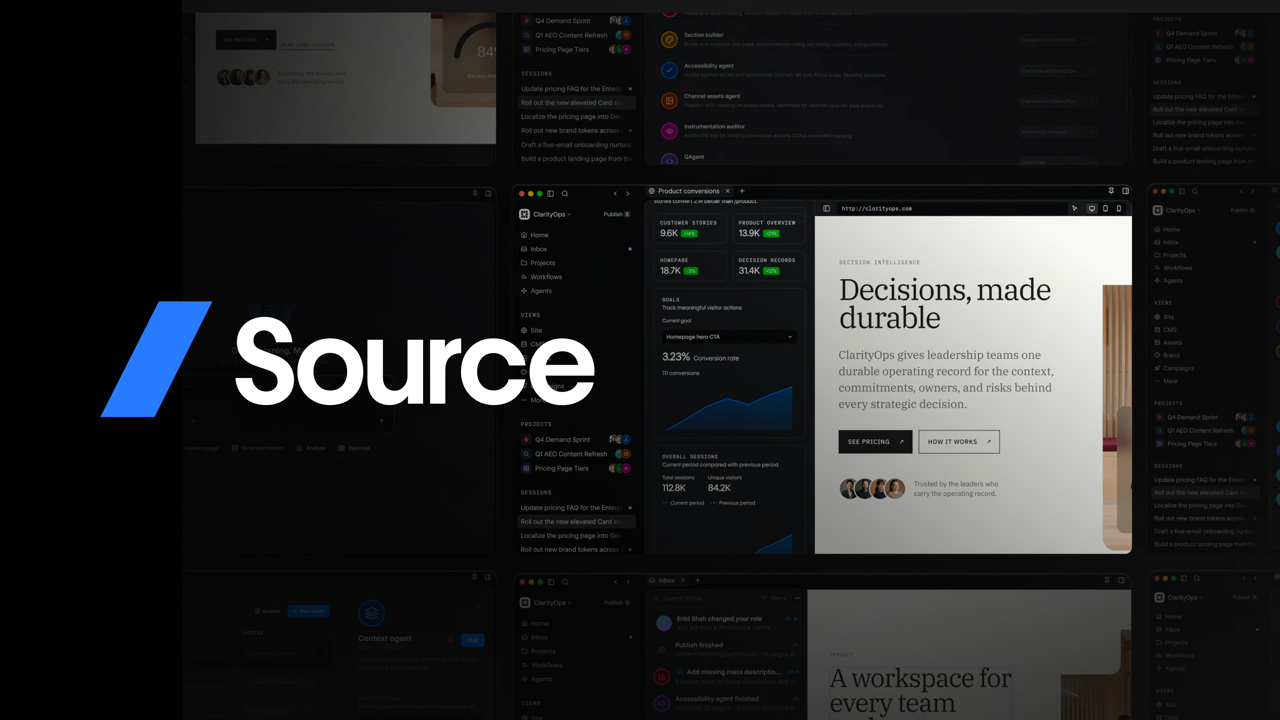
A View is a workspace dedicated to a specific role. Webflow provides six by default, organized in tabs: Audit, Agents, CMS, Inbox, Review, and Brand.
Webflow announced that a custom View can become a sellable product, installable on any project. Their phrasing: "turn your playbook into a product".
Agents that don't wait to be asked
"Agents don't wait to be asked." They monitor performance, flag opportunities in an inbox with the work already drafted, and execute upon approval. Examples provided include AEO fixes, CRO testing, and pages with dropping conversion rates. You can also create agents tailored to specific tasks.
A composable stack
Source connects to your existing codebase, CMS, marketing tools, and hosting, or to the Webflow stack. Sites already built on Webflow are also supported.
Webflow does not name any specific frameworks and therefore makes no commitments regarding compatibility. The only two names on the page, Next.js and Astro, appear in a testimonial from a partner agency discussing their clients.
Governance
Brand systems, approval workflows, and audit logs from day one. Teams can set the level of agent autonomy and require human approval before any production deployment.
What Webflow promises agencies
Taking on work you previously turned down, because Source works with real code on any stack. Transforming your playbook into a product via sellable Views. And becoming the AI consultant your clients are asking for.
Key takeaways: Code as the foundation, one View per business function, proactive agents that don't wait to be prompted, a composable stack, and governance from day one.
What this says about Webflow's strategy
Webflow is decoupling from Webflow, and that is the most significant move in the announcement.
The model used to be simple: build with us, host with us, edit with us. Source powers a codebase that Webflow didn't generate, with the CMS and hosting already chosen. Hal Zeitlin, from the agency Candid Leap, confirms this in his official testimonial: for their clients on Next.js and Astro, Source will be their new default.
Webflow has over 300,000 companies and 2,000 certified partners. Changing the nature of the product with a base like that is a calculated bet, not a test.
One point that Webflow didn't highlight on stage, but wrote in their FAQ: when Source is ready for you, and if you choose to migrate to our new platform, we will provide a guided path.
Key takeaways: Webflow now powers sites it didn't build, and its own FAQ refers to Source as its new platform.
The layer that disappears: there were no other solutions
We tested MCP 2.0 thoroughly, including for development.
In practice, it's not up to par. It's very slow, and you consistently have to go back and fix its work.
On the other hand, for data and encoding, MCP is incredible. It works very well within the CMS. It handles site audits quickly and cleanly. And it also manages time-consuming, repetitive tasks: fixing broken links, JSON-LD schemas, and alt tags on hundreds of images.
| Type de tâche | Notre constat sur le MCP 2.0 | Verdict |
|---|---|---|
| Construction de composants depuis un design | Il vérifie le design system, crée le composant manquant et respecte les conventions de nommage, mais très lentement et avec une reprise systématique derrière | Plus rapide à la main |
| Manipulation du CMS | Création, mise à jour et structuration d'items en volume, sans dérive | Excellent |
| Audit de site | Balayage complet et restitution structurée en une fraction du temps manuel | Excellent |
| Tâches répétitives (liens morts, schemas JSON-LD, balises alt) | Traitement en masse fiable sur des centaines d'éléments | Excellent |
Our conclusion before the conference: the Designer's abstraction layer was the bottleneck.
Webflow just said the same thing in the Source FAQ: code is the native language of AI, and when agents work directly with the code that ships, they understand the entire system. Then, it states verbatim that this is a fundamental shift from how Webflow has historically operated.
Key takeaway: The abstraction layer is what’s holding back the MCP today; we see it in production, and Webflow has just publicly acknowledged it.
What else is lost
A content manager publishing in the Editor cannot break the site. The security came from a constraint, not a set of instructions.
Source replaces this constraint with governance. In practice, a well-designed process doesn't have the same robustness as a technical impossibility.
The day after the announcement, the conference featured a talk titled "Agents in production: who approves, who ships, who's accountable," hosted by two people from Webflow.
Gartner places agentic marketing at the peak of inflated expectations on its 2026 hype cycle, with 17% of organizations having actually deployed AI agents.
Key takeaway: A marketing team couldn't break the site because they didn't have access to it, and that security is now becoming a process.
What this changes for a Webflow agency
The cost of a poorly built system has shifted to a new order of magnitude. Inconsistent naming, duplicate classes, and components that do three things at once used to just mean slower development. An agent writing into that code doesn't just slow things down—it makes mistakes: it creates a fourth "hero" component because the existing three aren't distinguished by any readable convention, and it does so at scale.
Views turn expertise into a product. An agency that understands how a marketing department works in a specific sector can encode that process and install it for all its clients in the same industry.
Governance becomes a deliverable. Deciding what an agent can modify on its own, what requires approval, and what happens when it makes a mistake on a lead-gen page—these are design decisions.
The open question remains: for which types of clients? A twenty-person team in a well-equipped scale-up doesn't have the same needs as a forty-employee SME with a single marketing manager.
Key takeaways: A poorly built system no longer just costs you speed, it leads to agent errors; Views allow you to sell a product instead of just hours.
What this means for a marketing team
The promise is autonomy without dependency on developers. This is already partly what Webflow provides them today.
A useful agent is one that has context, and the Source page designer perspective puts it well: you must encode your brand system, components, styles, and voice and tone.
Without a documented design system, voice guide, or written editorial rules, the agent will produce mediocre—politely mediocre—proposals, and you will end up having to rewrite everything.
Regarding visibility, Source includes an inbox where agents surface pre-written AEO corrections. If you're getting your acronyms mixed up, we've written the difference between AEO, AIO, and GEO.
Webflow claims its AEO clients achieve 70% more mentions and 120% more citations than brands not using their service. This internal data is described as a "directional finding," measured from May 19 to July 13, 2026, comparing 158 clients who implemented AEO recommendations against 187 clients who received them but did not implement them. Both groups are Webflow clients. The study measures the effect of implementing recommendations, not the comparison suggested in the title.
Webflow also presented an analysis of 2,000 sites via its chief evangelist, Guy Yalif: the median company appears in 16% of the AI responses it targets and is cited in only 6% of those.
Key takeaways: What Source brings to the table depends on what you have formalized beforehand: design system, brand voice, and editorial rules.
Our reservations, and there are several
When will it be ready?
Limited research preview, with enrollment rolling out in phases "over the coming months." No general availability date, no public milestones. We have submitted our access request.
How much will it cost?
Nothing, and that is the first question our clients will ask. According to the Webflow team, pricing will be largely based on AI consumption, as Webflow introduced AI credits to all Workspace plans on May 13, 2026.
Will it actually work?
Linda Tong outlined a vision of a future where developers, designers, and agents work in real time, then, according to CMSWire, added that we are still a long way off. She was referring to the state of the market, not her product. A product that needs to bridge a gap its own CEO deems very wide will not be mature in its initial versions.
Who owns the code, and who reviews the agents?
Four questions without public answers. What is the scope of the review process? How do you roll back a change that looks correct but breaks tracking? What happens if the client leaves Source after eighteen months? How does an external developer work on the same repository? Releases, in beta later this year, allows for branching the entire site with a Release Manager: likely part of the answer, but not all of it.
Two platforms, one roadmap
Webflow maintains that the current platform is not going anywhere, which recent releases confirm: MCP 2.0 then 2.1, native AEO agents, and AI Code Components. We simply observe that in the history of software companies, attention and the best engineers follow the new product.
For what type of clients?
Webflow says "modern marketing teams." That is broad. We see it making sense starting from a certain team size and a certain level of brand formalization.
Key takeaways: No date, no price, no answers regarding code ownership, and two platforms to maintain in parallel.
Two questions we've already been asked
Do you need a developer to use Source?
For day-to-day use, no: Webflow positions Source against tools that force an engineering workflow, opting instead for roles, permissions, and approval paths. To set it up, yes. Connecting a codebase and configuring guardrails requires a technical profile.
Does Source replace the work of an agency?
It shifts it. Building pages is becoming less valuable, while architecting systems that an agent can operate without error is gaining value, and designing the governance model is becoming a deliverable in its own right.
Key takeaways: Source doesn't require a developer for daily use, but it does need one for the initial setup.
Our current stance
We’re excited, but cautious.
Excited because Source finally addresses a real market need, not just a wishlist. We’ve been waiting a long time for Webflow to take a clear stance on agentic AI, and here it is.
Cautious because a product in research preview with no release date or pricing isn't something to recommend yet. And cautious because we’ve already seen a very promising tool, the MCP for the build side, disappoint in practice. The same gap as when taking over a site built with AI six months after it went live.
We still have questions: the pricing, whether it will truly be ready, and where agencies fit into all of this. We’ve requested access; we prefer to test it before telling anyone what to do with it.
In the meantime, the advice that holds true regardless of the future of Source: if your site doesn't have a clean design system, consistent naming conventions, and a structured CMS, no agent will save you.
This is the work we put into every project, whether it's a new build or a revamp of an existing site. If you'd like to know where yours stands, let's talk.
Key takeaways: We are on board with the vision, we have requested preview access, and we won't recommend anything to a client until we've tested it ourselves.
We migrated their site to Webflow
Discover our case studies and results.