
Salomé Sperling

Lead Creative Webdesigner
Summary of the article
- Assets is designed to let agents find your approved assets, understand them, and adapt them across channels, leveraging the design system and brand variables. It also handles video, including editing and subtitling for social media.
- The technology comes from Vidoso, a company acquired by Webflow, with the acquisition announced on March 12, 2026.
- This is the least developed of the three announcements. The press release mentions a first look, and the two official sources provide very different dates.
- Our main concern is brand consistency: adapting a visual from one format to another means recomposing it, and that is where the brand identity can break down. Furthermore, Webflow does not address the issue of asset usage rights at all.

Summarize with AI
What is Assets?
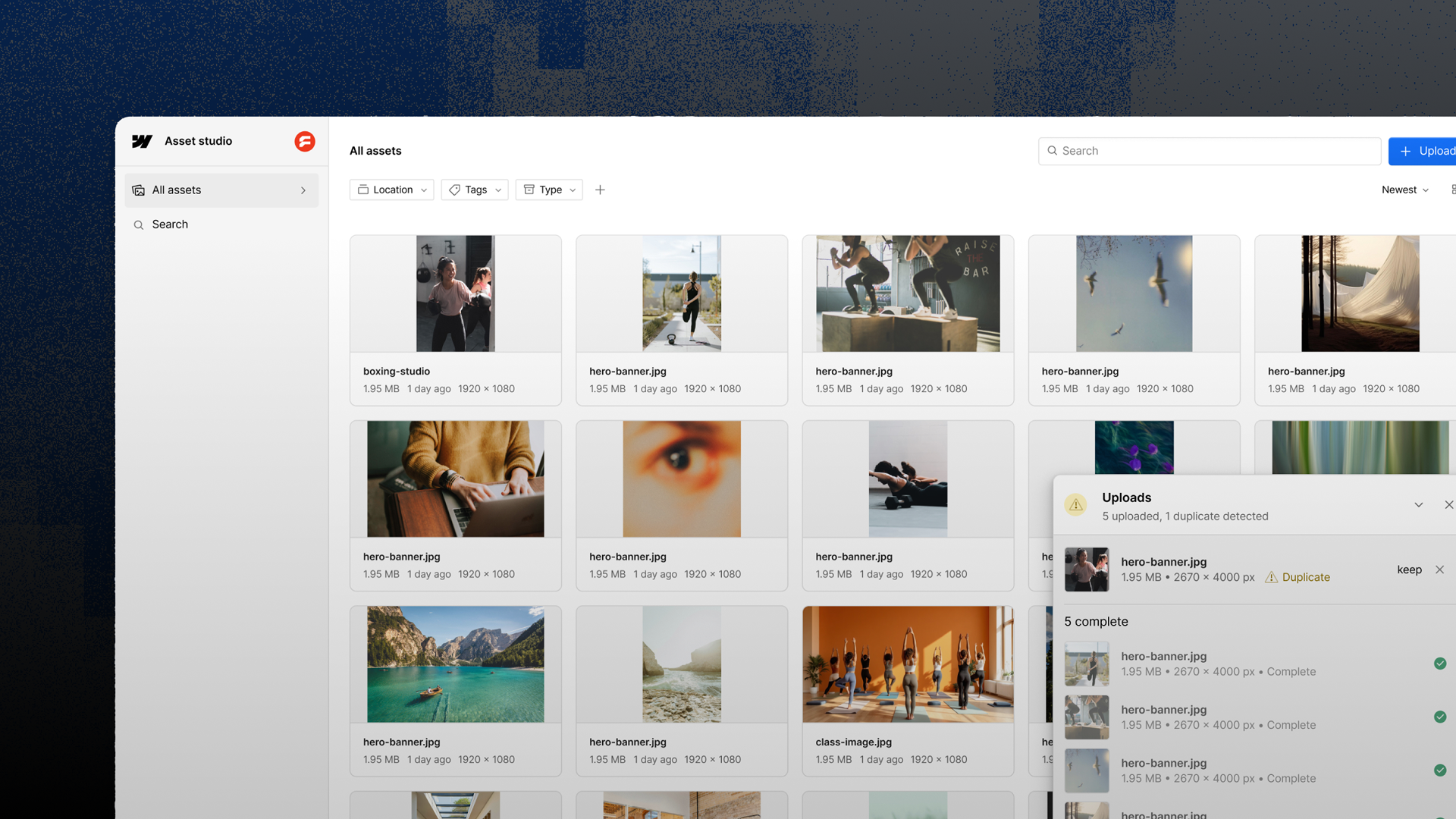
Webflow introduces Assets as a new agentic way to create brand-consistent creative assets directly within Webflow.
In practical terms, agents locate your approved assets, understand them, and adapt them for different channels. This covers everything from resizing visuals for a website to editing videos for social media—all without needing to export between tools.
The design system and brand variables serve as the context.
Key takeaways: Assets is designed to find, understand, and adapt your approved assets across channels, including video, by using the design system as context.
Where the technology comes from
Assets was not developed internally by Webflow. It is based on technology from Vidoso, a company acquired by Webflow. Webflow does not provide a specific date for the deal, stating only that it took place earlier this year, with the acquisition announcement published on March 12, 2026.
The issue identified by Webflow at the time of the acquisition: content is produced quickly, but it isn't always accurate. It doesn't look or feel like the brand.
Vidoso generates visuals and videos that adhere to brand guidelines, remain consistent across campaigns and channels, and integrate into existing marketing team workflows. Webflow refers to these as AI-generated assets that are production-ready by design.
Key takeaways: The technology comes from Vidoso, acquired earlier this year, and it addresses the problem that while generated content is produced quickly, it often fails to reflect the brand.
Creating or adapting: Webflow claims both
Webflow presents Assets as an agentic way to create brand-consistent creative assets. In the same announcement, it describes agents that find, understand, and adapt existing, pre-approved assets. The press release does the same: it speaks of creating assets with the help of specialized agents, and immediately follows up by mentioning the adaptation of approved assets, including video.
Both verbs coexist, and the boundary is never defined. Yet, it changes everything.
Key takeaway: Webflow uses both verbs, create and adapt, without specifying where the line is drawn, even though the level of risk differs significantly between the two.
The context layer, the word that ties the whole week together
In its acquisition post, Webflow explains that Vidoso's technology strengthens its context layer. It is the marketing operating system that encodes brand rules and structure, ensuring that AI generation is reliable and aligned rather than generic.
Source provides agents with code as context. Campaigns gives them a brand system derived from the site. Assets provides the design system and variables. Agent Instructions give them the written guidelines. Webflow isn't selling AI; it's selling the context that makes AI usable.
Key takeaway: Webflow refers to the layer that encodes brand rules to ensure AI reliability as the context layer, and it is the common thread connecting Source, Campaigns, Assets, and Agent Instructions.
Our main reservation: adapting means recomposing
Adapting a visual from one channel to another is not just resizing it. A square format for Instagram, a vertical format for stories, a horizontal banner: the composition changes every time. What was in the center moves to the side, and text that fit on two lines now takes up four.
A design system dictates which colors, text sizes, and spacings are permitted. It does not dictate what makes a composition work.
Key takeaway: Adapting a visual from one format to another requires recomposing it, and a design system does not contain the principles that make a composition work.
The topic no one is talking about: usage rights
An approved asset is not approved for everything. A photo purchased under a web license is not necessarily licensed for paid social media. A photoshoot with a model has a rights duration, often one or two years, and sometimes restricted by territory. An image of a client in a case study was approved for that study, not for an advertisement.
An agent that retrieves, understands, and adapts approved assets must be aware of all this.
Nothing in the announcement indicates how an asset's licensing scope is tracked, or if it is tracked at all.
In the meantime, the rule we will apply is: assets with limited licenses will either be excluded from the library the agent can access, or included only with their expiration date and scope clearly stated in the filename.
Key takeaway: An approved asset is not approved for all channels or for all time, and there is no indication that Assets is aware of the licensing scope of the files it adapts.
Video: the part that will work
Editing and subtitling videos for social media is a tedious, repetitive task with no creative stakes. It is exactly the type of task where AI excels today.
Subtitling also has a benefit that is never mentioned enough: accessibility. A subtitled video is accessible to the hearing impaired and can be watched without sound, which is how the majority of videos are consumed on mobile.
Key takeaway: Video editing and subtitling are the most credible parts of the product, and systematic subtitling also improves accessibility.
What this changes for a marketing team
Every marketing team we work with has a creative backlog, and no one has enough designer time to adapt every visual into six different formats.
You need an organized asset library. Not just a Drive folder with four thousand files named final-visual-v3-OK.jpg. An agent tasked with finding and understanding approved assets needs to be told which ones are approved, for what purpose, and until when.
Key takeaway: Assets addresses a real creative backlog, but it assumes an organized and documented asset library, which few teams actually have.
What this changes for an agency
This announcement affects the designer's work, not the developer's.
Adapting formats was already a task we were looking to reduce, because it occupies a designer without helping them grow, and because clients are reluctant to pay for the time it takes. If Assets handles it properly, no one on our team will complain.
What gains value is the decision-making process. The original graphic design choices that give a visual its intent. The composition rules that must be encoded to ensure the adaptations don't go off the rails.
Key takeaways: Adapting formats is the part we were already looking to reduce, and what remains feels more like art direction than execution.
Our reservations
The two dates, and the gap is significant
The summary of announcements states that Assets enters beta in October. The press release from the same day places asset production at the beginning of next year.
Our interpretation, though not certain: the October beta is limited, and wide availability will come later.
The term first look
The press release does not mention a launch, but rather a first look at a new way to create brand-consistent assets within the platform.
Pricing
Nothing has been announced, just like the other two. For a product that generates images and video, computing consumption is significantly higher than for a product that writes text or code.
Integrating acquired tech
Vidoso was built outside of Webflow, with its own model of what a brand and an asset are. Assets must now be able to read Webflow's design system and variables.
Key takeaways: Two dates ranging from October to early 2027, a press release mentioning a first look, no pricing, and acquired technology to integrate.
Our current position
This is the announcement we are most skeptical about and the one with the least urgency.
Least urgent because nothing will be usable before October at best, and likely not until 2027 in practice.
Organize asset libraries for clients where it makes sense, noting what is approved, for which channel, and until what date.
Key takeaways: Nothing to decide right now, but organizing and documenting your asset library is immediately useful and determines what Assets will be able to do.
These businesses have migrated to Webflow
And their marketing teams thank us for it.