
Salomé Sperling

Lead Creative Webdesigner
November 27, 2026
Summary of the article
- A rebrand is justified when several signals overlap: an offer that changed without the brand following, a message nobody grasps in five seconds, a site your sales team avoids sending, a merger or expansion, or conversion dropping at constant traffic.
- A single, purely visual signal, such as a dated logo or a tired visual identity, calls for a refresh, not a full brand overhaul.
- The five-second test: show your homepage for five seconds to someone outside your industry, then ask what you sell and to whom.
- The order of work matters as much as the decision itself: strategy, positioning, and tone of voice before the first visual direction. A logo placed over a fuzzy positioning just relocates the problem.
- A full rebrand engagement at We-R takes eight weeks on average, from brand audit to brandbook delivery, rollout excluded.

Summarize with AI
A rebrand is never a good call to make out of sheer visual fatigue. It's a good call when several concrete signals overlap: an offer that changed while the brand didn't follow, a message nobody grasps on the first try, a site your sales team has stopped sending. Here are the five signals that come up most often, and the rule for knowing whether you need a refresh or a full rebrand.
Rebranding: a question that never shows up at a convenient moment
It always arrives sideways, never as a line item on an agenda. A prospect who gets your business wrong, a salesperson who sends a PDF instead of a link, a new service that never found its place on the site. Taken one at a time, each of these irritations ends up on the someday pile.
If you're first looking for what a rebrand actually is, in the strict sense, the definition and the three degrees of a brand overhaul are covered elsewhere. The question here is different: does my situation actually call for one?
The five signals below can be spotted without market research and without a budget. You either recognize them, or you don't.
Signal 1: Your offer has changed, your brand hasn't
This is the most common mismatch, and the most expensive one. The company has added a line of business, shifted its revenue model, or started targeting a different buyer, while the site, the logo, and the messaging keep describing the business as it was three years ago.
The typical case: a recruitment firm adds consulting and managed services. On paper, three offers. On the site, just one, the original one, because that's the one that built the reputation. The other two get pushed to the bottom of the page, when they show up at all.
This mismatch gets paid for early in the sales cycle. Prospects come to you for the old business, not the new one, and your sales reps spend the first call correcting a perception instead of qualifying a need.
Signal 2: A prospect can't tell what you do in 5 seconds
Five seconds is enough to measure the gap. Pull up your homepage in front of someone outside your industry, show it for five seconds, hide the screen, then ask what you sell and to whom. A vague or wrong answer says nothing about your design: it says your message can't stand on its own.
The real window is even tighter. The study by Gitte Lindgaard and her team, published in 2006 in Behaviour & Information Technology under the title "Attention web designers: You have 50 milliseconds to make a good first impression!", shows that a judgment formed after 50 milliseconds of exposure to a page already broadly matches the judgment formed after a much longer look. The Nielsen Norman Group, drawing on an analysis of more than two billion page visits, puts the window at about ten seconds for a page to communicate its value proposition before a visitor leaves.
A flawless visual identity doesn't rescue a message that lists features, uses internal company jargon, or still speaks to last year's target buyer. That's a brand problem, not a design problem.
Signal 3: Your sales team avoids showing the site
Look at what your reps actually send after a first meeting. If it's always a deck, a PDF, or a demo, and never the link to the site, they've already made the call before you did: the site doesn't serve the offer the way they're selling it today.
They're rarely wrong. They hear the real objections all day and adjust their pitch every week, while the site's pages date back to the last redesign. The gap between these two versions of the story is the cheapest signal you have.
The nuance that saves you from an expensive mistake: a site that doesn't get sent because it's missing a pricing page, a recent case study, or a page for the new offer doesn't call for a rebrand. It calls for a page. The signal only counts if the complaint is about what the site says about the company, not about what's missing from it.
Signal 4: A merger, acquisition, or international expansion changes the equation
These events make the brand factually wrong, not just dated. Two names coexist, two visual identities circulate across sales documents, and clients aren't sure which entity signs what. Internationally, a name that worked in one market turns out to be unpronounceable, already trademarked, or carries an unintended meaning in the next one.
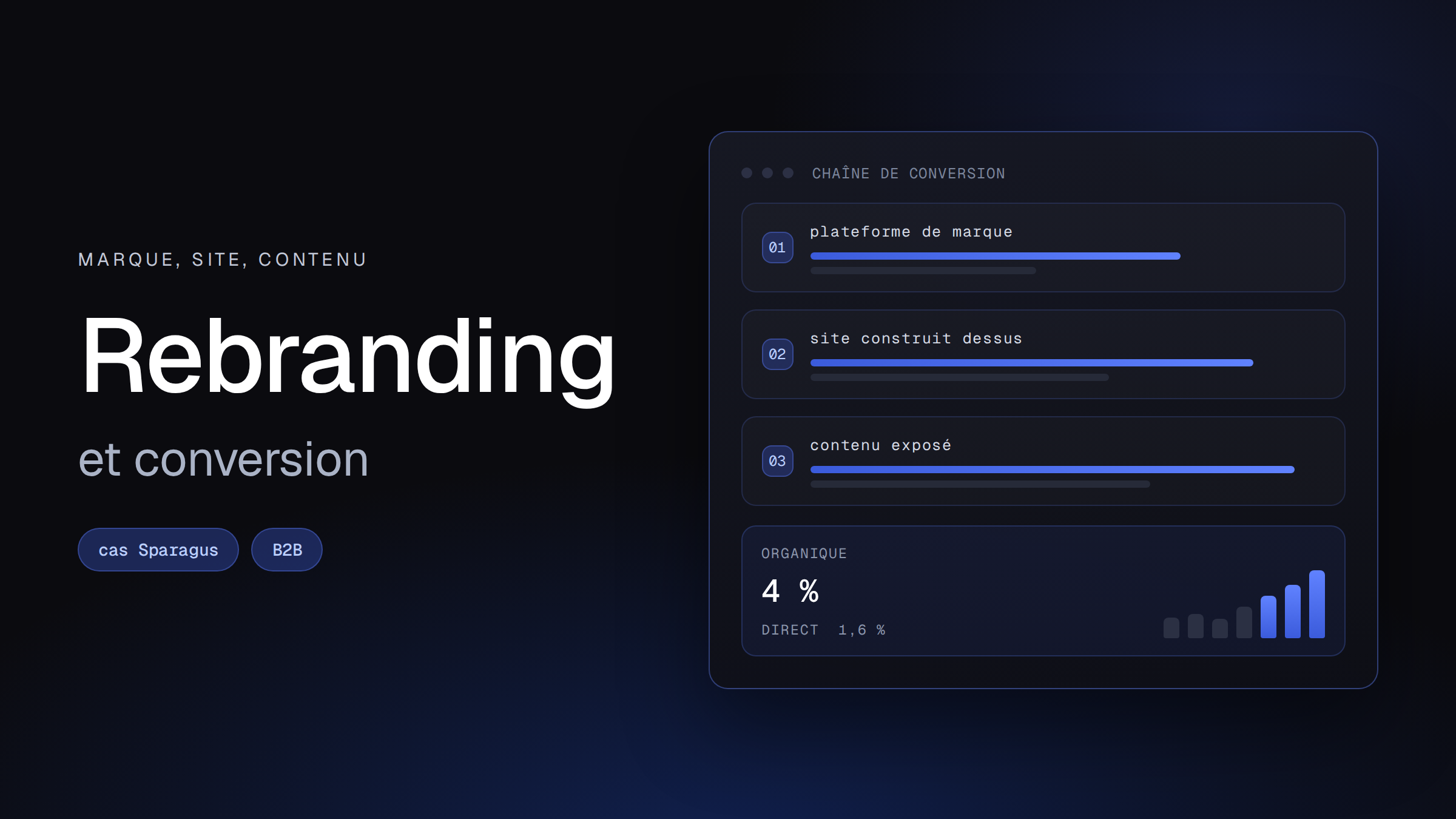
Sparagus, founded in 2017 in recruitment, extended its model into consulting and managed services with an international expansion. Its case study page puts it plainly: their image no longer reflected that transformation. The project therefore started with strategy, meaning mission, vision, offer, and tone of voice, before the first visual direction. What the rebrand changed for Sparagus walks through that order of work.
That order isn't an agency preference. A logo laid over a positioning that's still fuzzy just relocates the problem: six months later, the company has a more polished identity and the same difficulty describing itself in one sentence.
Signal 5: The site stopped converting, and it's not a traffic problem
Same traffic, same sources, fewer inquiries: the problem has moved to what happens after the click. The page gets seen, it gets read, and it doesn't convince.
Before blaming the brand, rule out three causes that are far cheaper to fix: a broken form or a conversion tracker that stopped reporting, a load time that's drifted, a campaign that quietly changed its audience. All three produce exactly the same symptom.
If those check out clean and the drop persists, the brand hypothesis becomes a serious one. What a rebrand really changes about conversion breaks down, link by link, what moves once the site is rebuilt on the new identity, and what doesn't.
Rebrand or simple brand refresh: how to decide
A single signal, and a mostly visual one, calls for a refresh. Several overlapping signals call for a full rebrand. This rule holds up better than others because it looks at what's changed inside the company, not at what's gone stale on screen.
| What you're observing | What it calls for |
|---|---|
| The logo and visual identity have aged, the message still holds up | A visual refresh |
| A prospect doesn't understand the offer, but the offer hasn't changed | Messaging and page-hierarchy work |
| The offer, the target buyer, or the business model have changed | A full rebrand, strategy first |
| Merger, acquisition, entry into a new market | A full rebrand, including the question of the name |
| Two or more signals overlap | A full rebrand |
A refresh isn't the discount version. It preserves what's already working and costs considerably less, both in budget and in lost recognition.
Because a full rebrand spends recognition capital before it rebuilds any. In January 2009, PepsiCo launched new packaging for Tropicana Pure Premium: volume sales dropped by about 20% between January 1 and February 22, according to Information Resources data reported by Ad Age, and the company announced a return to the old packaging on February 23. The example comes from consumer packaged goods, where visual attachment weighs far more heavily than for a brand whose audience is a few hundred decision-makers. It's still a reminder: you don't replace a mark the market already recognizes without a documented reason.
That's exactly what a brand audit exists to establish before any work begins: what's worth keeping, what needs to go, and to what degree.
What a rebrand actually involves
Count on eight weeks on average, and a non-negotiable order of work: strategy before visuals. Here are the stages of our branding engagement, as they actually run:
| Stage | What comes out of it |
|---|---|
| Brand understanding | Audit of the business model, positioning, competition, and customers |
| Strategic exploration | Mission, vision, values, and unique mechanism |
| Inspiration concepts | Creative directions aligned with strategy and market |
| Concept presentation | One concept applied across formats, logo and print included |
| Visual and verbal identity | Structured visual identity and verbal identity |
| Brandbook and assets | Full brandbook, usage rules, and graphic files |
The timeline depends mainly on how mature the starting identity is. A company that already knows what it sells and to whom moves quickly through the first two stages. One that discovers during the audit that its three offers don't tell the same story will spend more time there, and it's time well spent.
Rollout is the stage where rebrands stop too soon. A brandbook delivered and then left in a shared folder, while the site, sales documents, and external profiles stay on the old identity, produces nothing. Some of our clients, in that situation, move straight into the site rebuild with the same team, which avoids re-explaining the strategy to a new provider who wasn't in the room when it was written.
Do two or three of these signals sound familiar at once? The brand audit that opens the engagement exists precisely to settle whether you need a refresh or a full rebrand, and the detailed quote comes after that audit, once the scope is known. If you're further along and comparing providers, how to choose a branding agency in Brussels walks through the criteria.
We have supported these companies in their brand redesign
Discover our case studies and results.