Salomé Sperling

Lead Creative Webdesigner
November 26, 2026
Summary of the article
- A rebrand doesn't produce a measurable business result on its own: it builds the foundation a website and content can later produce one from.
- At Sparagus, the published figures (organic traffic converting 2.5 times better than direct, 4% against 1.6%) come from the content strategy run after the rebrand and website redesign, not from the rebrand alone.
- Before that content strategy, 92% of Sparagus's Google clicks came from searches on its own name: a rebuilt but unexposed identity only reaches buyers who already know the brand.
- Three questions before launching a rebrand: does the positioning account for audiences and channels, will the website be rebuilt right after, and who will expose the new brand to real traffic?
- McKinsey estimates that B2B companies with a strong brand outperform those with a weak one by about 20%, but that's a correlation, not a promise attached to a new logo.

Summarize with AI
A B2B rebrand doesn't lift a website's conversion rate on its own. It puts the message back in order, and it's the website and the content built on top of that order that turn it into inbound demand. At Sparagus, the conversion numbers now published came a year after the new brand, once the whole chain was in place.
A rebrand that changes nothing about leads is a rebrand that failed
A brand can be delivered in full, logo, palette, brandbook, tone of voice, without a single commercial metric moving in the twelve months that follow. That's almost never a creativity problem. It's a chain problem: the new brand sits in a PDF while the website keeps telling the old story.
A rebrand changes the identity and, most often, the positioning of an already established company. The full definition of rebranding breaks down what separates it from a simple visual refresh.
The useful question before launching one isn't "does this look like us". It's "does this hold up in front of a prospect weighing us against two other providers". A brand is judged the moment someone compares, not the moment the leadership team sees the boards.
Why most rebrands have no measurable effect
Because they stop at delivery. The project goes to a specialist studio, which hands back a brand platform and a visual territory that's often very good, then the website redesign slips to next year's budget and the content stays the same as before. The new brand is never put in front of real traffic. Nobody can say whether it converts better, because nobody has tested it.
McKinsey's research on B2B branding shows that companies with a strong brand outperform those with a weak one by about 20%. That's a correlation, not a recipe: it says brand strength matters, not that a new logo manufactures it.
There's a second, more mechanical reason. The 95:5 model, put forward by John Dawes of the Ehrenberg-Bass Institute with LinkedIn's B2B Institute, estimates that at any given moment, only about 5% of a category's buyers are in an active buying phase. Dawes himself is careful to call it a heuristic, not a law, and the share shifts with how often a sector's customers buy. The implication still holds: a brand that's exposed nowhere is seen only by the handful of buyers already searching, and stays unknown to everyone else.
In practice, the usual split between providers does the rest of the damage. The branding studio stops at the brandbook, because that's its job and its scope. The agency rebuilding the website reuses the new guidelines without having sat in on the positioning decisions. The content, written later still, often by a third team, keeps using the old brand's words. Each link is correct on its own; the chain doesn't hold.
It's the same mechanism that often explains why your B2B website isn't generating leads. The message changed, but the channel meant to carry it never caught up.
The Sparagus case: a company that had outgrown its own image
Sparagus is a recruitment company founded in 2017. Its model has since expanded into consulting and managed services, structured around three offers and an in-house network of expertise, the Sparagus Hubs. By the time of the project, the company had passed 10 million euros in revenue and 100 consultants. Its image, though, was still the one from its early recruitment-only days.
The work delivered in August 2025 addressed substance first: mission, vision and trajectory, clarifying the three offers, the Hubs model, tone of voice, brand personality and target audiences, for both clients and candidates. The visual territory, the brandbook and the launch plan came after, in that order.
The order isn't a detail. When a company sells three different things to two different audiences, candidates and clients, the visual identity can't make the positioning call for you. It can only give shape to a decision that's already been made.
At this stage, no conversion numbers. That's what the Sparagus rebranding page shows, and it's what you need to accept before launching a brand project: a rebrand on its own doesn't produce a measurable commercial result. It produces the foundation something measurable can be built on.
What happened once the brand, the website and the content were aligned
The website came right after. Sparagus's new Webflow site was built on the brand platform that came out of the rebrand: same colors, same typography, same tone of voice across the copy, in French, English and Dutch. More than thirty pages built for conversion, a structured CMS, and an in-house team able to keep evolving all of it without going back through an agency.
The content strategy came next. Before it, 92% of Sparagus's Google clicks came from searches for its own name. The site was being found by people who already knew the brand, which is exactly the limit of an identity that's been rebuilt but never exposed.
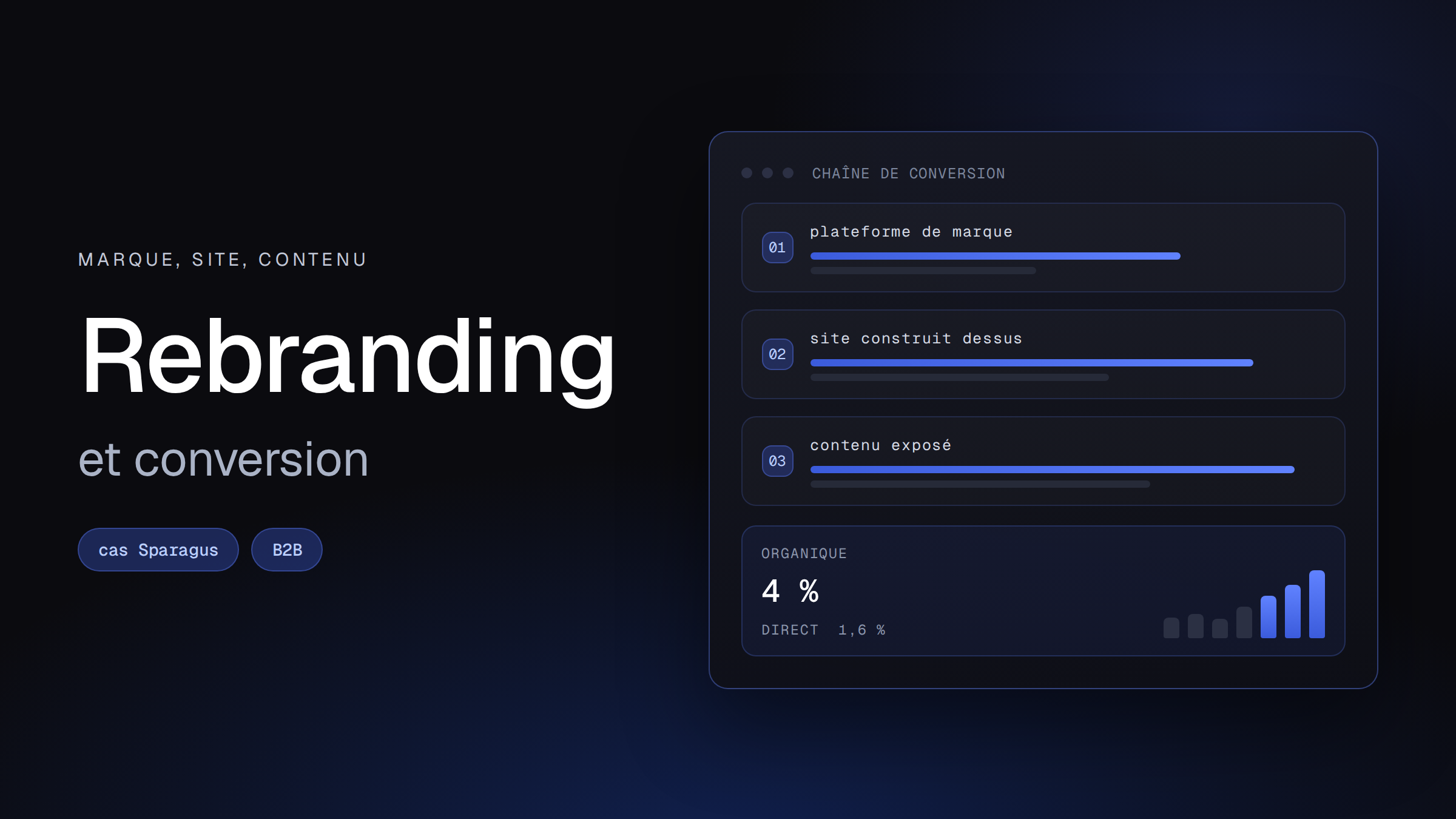
The two published figures show up at that point. Traffic from organic search converts 2.5 times better than direct traffic, 4% against 1.6%. And in September 2026, the site had its best month for applications of the year, up 80% against the average of the previous eight months.
Those results belong to what the SEO and GEO strategy changed next for Sparagus, not to the rebrand taken on its own. The nuance cuts both ways. That content would have had no coherent message to carry without the repositioning, and the repositioning would have produced nothing measurable without it.
One honesty check: an 80% increase compares one month against an eight-month average. It's a trajectory signal on a site that, until then, was mostly capturing its own brand name, not a promise you can reproduce as is.
What to check before launching a rebrand if the goal is to generate leads
Three checks rule out most projects that won't produce anything.
Is the positioning built around target audiences and channels, or only around identity? Ask who the chosen audiences are, what they're looking for, and which path brings them to you. If the answer is just moodboards, the project is a design project, not an acquisition one.
Will the website be rebuilt on the new brand platform, and on what timeline? A gap of several months between the new guidelines and the website is enough to lose the benefit, because the brand keeps being encountered in its old version. In our branding engagements, which run eight weeks on average, the website's architecture starts as soon as the visual identity is signed off.
Who exposes the new brand to real traffic, and with what? Without a content plan behind it, a rebrand stays an exercise in internal pride: the team loves it, the market never meets it.
This reasoning has limits, and they're worth stating. A company whose pipeline comes entirely from referrals, tenders or outbound sales won't see its web conversion rate move, however good its brand is: its website isn't where the decision gets made. And when the name change comes from a merger or a trademark conflict, the rebrand is an obligation to execute cleanly, not a growth lever to justify. Changing identity also costs you some of the recognition you'd built up: that's a real cost, to weigh against the expected gain.
| Link | What it produces | What it doesn't produce | Sign it's working |
|---|---|---|---|
| Rebrand (positioning, identity) | A clear message, defined audiences, a visual territory | Traffic, leads, a conversion rate | The sales team picks up the new arguments without rephrasing them |
| Website built on the brand | A journey that carries that message, pages built to convert | New demand, on its own | Content keeps evolving without going through an agency |
| Organic and AI content | Measurable inbound demand, beyond brand-name search | A credible brand if the message is unclear | The share of clicks outside brand-name search goes up |
Sparagus had all three links with the same team, in that order, and that's why the numbers exist. If you're unsure about your current brand, the useful starting point isn't a moodboard: it's a brand audit, to see what your identity is actually telling your buyers and where it's losing them. That's the first step of our rebranding and brand strategy approach.
We have supported these companies in their brand redesign
Discover our case studies and results.