
What is Airtable?
Airtable is a no-code database that is presented as an advanced spreadsheet, allowing you to organize business information with customizable views and relationships between tables.
Each database can contain several linked tables, which makes it possible to model sales pipelines, product catalogs, projects, or content.
With its grid, kanban, calendar, form or gallery views, Airtable becomes a central support for coordinating teams and data.
Airtable combines the ergonomics of a spreadsheet with the structure of a lightweight relational database.
Key features for B2B teams
- Relational tables to manage customers, deals, projects, projects, content or tickets, with links between records.
- Multiple views (grid, kanban, calendar, timeline, form) to adapt the display to the needs of each team.
- Rich fields (selectors, attachments, links, links, formulas, rollups) to finely structure the data.
- Native automations to trigger emails, update records, or call webhooks.
- Designer interface to create internal mini-apps on top of the box, without development.
Airtable is quickly becoming the shared data base between marketing, sales and operations teams.
For whom and in what contexts?
Airtable is particularly suitable for SMEs, agencies and B2B teams who need a single repository to monitor their operations without setting up a heavy ERP.
It is well suited for teams that manage a lot of lists (customers, content, content, partners, projects) and who need to filter, sort, and collaborate on this data on a daily basis.
- Agencies and marketing teams that manage campaigns, content, budgets and reporting.
- Sales teams that manage a simple pipeline or strategic accounts in addition to a CRM.
- Operations teams that monitor projects, service providers, internal requests or stock.
Airtable is suitable for organizations that want to centralize their business data without switching to a tool that is too complex.
Airtable price
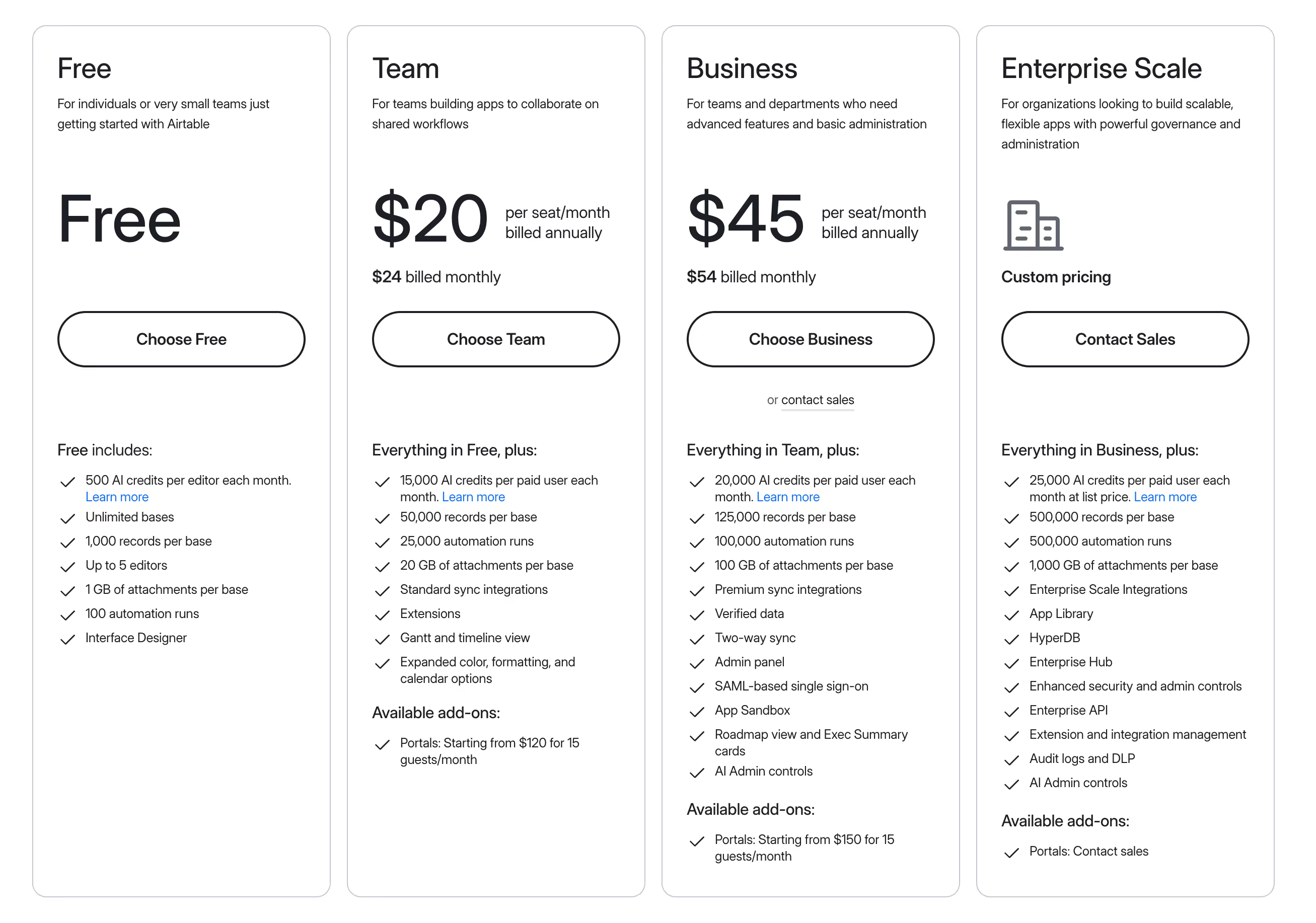
Airtable offers pricing based on the type of plan And the number of editors, with several levels of functionality. The grid is based on a Free plan, then Team, Business and Enterprise Scale plans designed for growing collaboration and administration needs.
- Free plan: adapted to individuals or very small teams, with unlimited databases, a limited number of recordings and automations, and a limited number of editors.
- Team Plan: for teams that build apps on shared workflows, with more records per base, more automations, more storage, and additional views (gantt, timeline, etc.).
- Business plan: intended for teams and departments that need advanced features (premium sync, admin panel, SAML SSO, sandbox, AI controls, etc.) and significantly higher volumes.
- Enterprise Scale: a tailor-made offer for organizations with strong governance, security and scalability requirements, with advanced integrations, extensive API, audit logs and extensive admin controls.
Airtable remains affordable to start on the Free or Team plan, but the needs for registrations, automation, and governance naturally make the switch to Business or Enterprise plans as the platform becomes central to the organization.
We-R Airtable review
Airtable is a great companion for structuring data around a Webflow site or an ecosystem of marketing tools.
Its flexibility makes it an excellent support for content, campaign or commercial management workflows, especially when combined with an automation tool like Make or n8n.
- Centralize the content (pages, articles, assets) used on a site or in campaigns.
- Track leads, deals, and key accounts when a comprehensive CRM would be oversized.
- Serve as an intermediate base between Webflow, CRM and other tools through automations.
The limit: for very structured or regulated needs, a real CRM or a dedicated business tool may become necessary.
Airtable is ideal as a flexible business database, as long as you remain vigilant about database governance and growth.
Alternatives and tools similar to Airtable
Several solutions are positioned on the same ground as Airtable.
- Notion: more documentation and wiki oriented, with integrated databases.
- Smartsheet: similar to a spreadsheet, but with advanced project management features.
- Dedicated databases (HubSpot, Pipedrive, Monday.com): more vertical, but less flexible than Airtable's generic approach.
-
Compared to alternatives, Airtable stands out for its flexibility and for the variety of its views to exploit the same data from different perspectives.