Salomé Sperling

Lead Creative Webdesigner
Summary of the article
- ChatGPT isn't "indexed" like Google: it searches the web, reads sources and recommends the brands that come up most often, with the clearest proof.
- Three things move a brand in its answers: pages that genuinely help buyers choose, a website AI reads effortlessly, and mentions on the third-party sources it consults.
- At Linker, a PR agency we've supported since January 2026, this work made it the agency most cited by AI in its market, and SEO and AI now account for 52% of its leads.

Summarize with AI
To appear in ChatGPT, your brand must be found when the AI searches the web, understood when it reads your site, and confirmed by other sources. There is no registration form or paid option. It requires foundational work that can be measured.
ChatGPT reported 800 million weekly users in October 2025 (OpenAI, DevDay 2025). Some of your prospects are already asking it "which agency," "which software," or "which provider" they should choose. The question is no longer whether it matters, but whether your name comes up.
How ChatGPT chooses the brands it cites
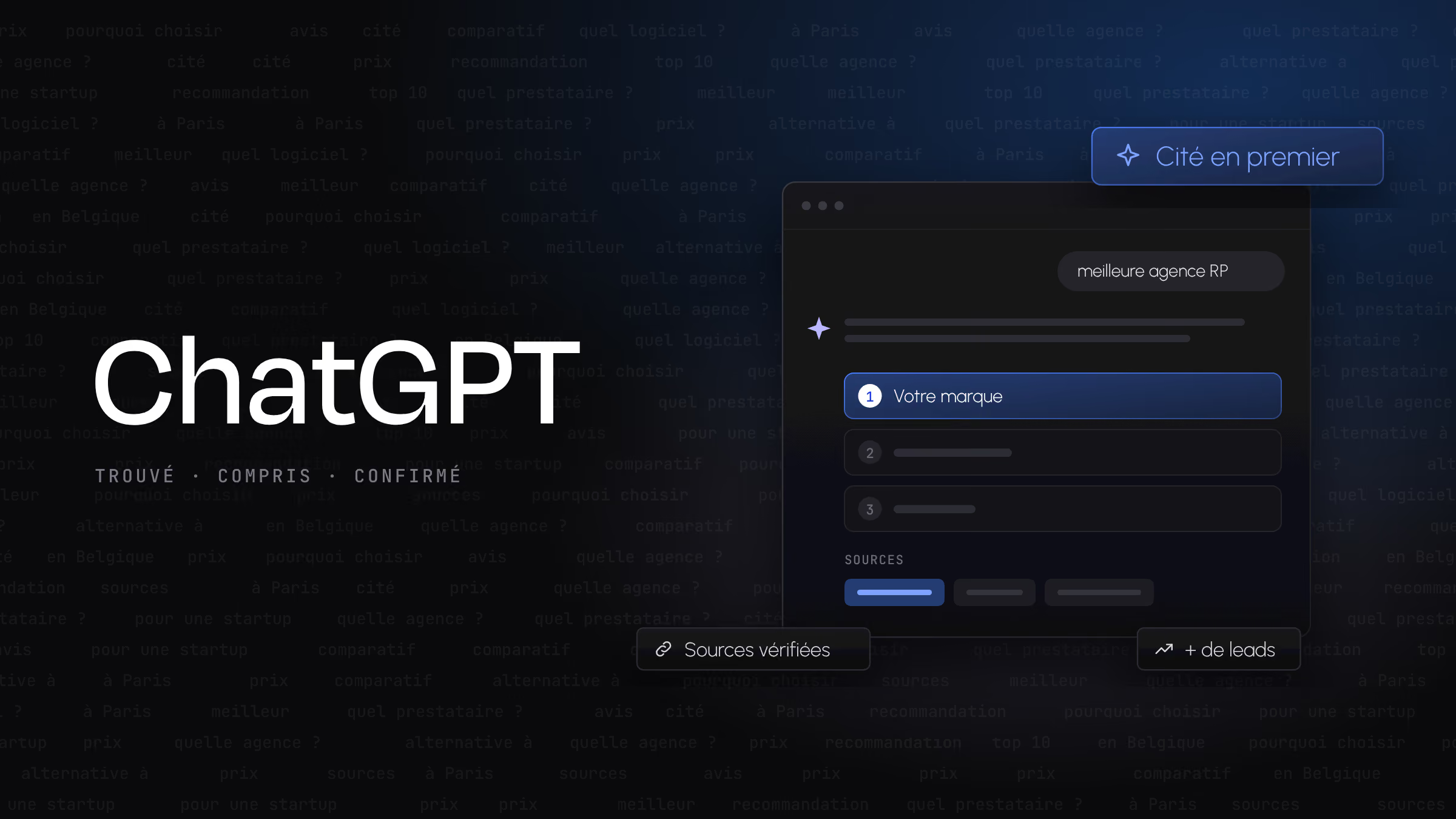
ChatGPT responds in two ways. For general questions, it draws from what it learned during its training. For recent or commercial questions, it launches a web search via third-party engines, including Bing, reads about a dozen pages, and drafts its response based on them.
It is this second mode that matters for a business. When a prospect asks "which PR agency for a tech startup," ChatGPT does not consult an official ranking. It reads comparisons, directories, articles, and the sites of the players themselves, then recommends the names that appear frequently, with verifiable arguments.
There are two consequences. A brand absent from search results is unlikely to be read. And a brand that is well-ranked but vague about what it does will be read, then ignored.
Why your brand isn't appearing (yet)
In the audits we conduct, we almost always find the same causes:
- the site speaks to too many target audiences at once, and the AI doesn't know for whom you are the right answer;
- no page answers the questions a buyer asks before choosing (price, comparison, use cases, industry);
- proof is absent or unverifiable: no figures, no named clients, no methodology;
- the brand exists nowhere other than on its own site;
- no one is measuring, so no one knows whether ChatGPT is recommending them or not.
What we work on with our clients
Our SEO & GEO consulting is based on five pillars. They move forward together, because no single one is enough on its own.
1. A positioning that the AI can summarize in one sentence
Before writing, we make a decision: for whom is the company the best answer, on which topics, and against whom? An AI recommends a brand when it can say in one sentence why it is suitable for the person asking the question. If you cannot formulate it, neither can it.
2. Pages that help with the decision-making process
AI models cite content that helps them answer buying-related questions: industry or use-case pages, comparison guides that honestly name competitors, pricing pages, quantified case studies, glossaries, and FAQs. Each page addresses a real buyer question, providing a direct answer in the very first lines.
3. A site that AI can read effortlessly
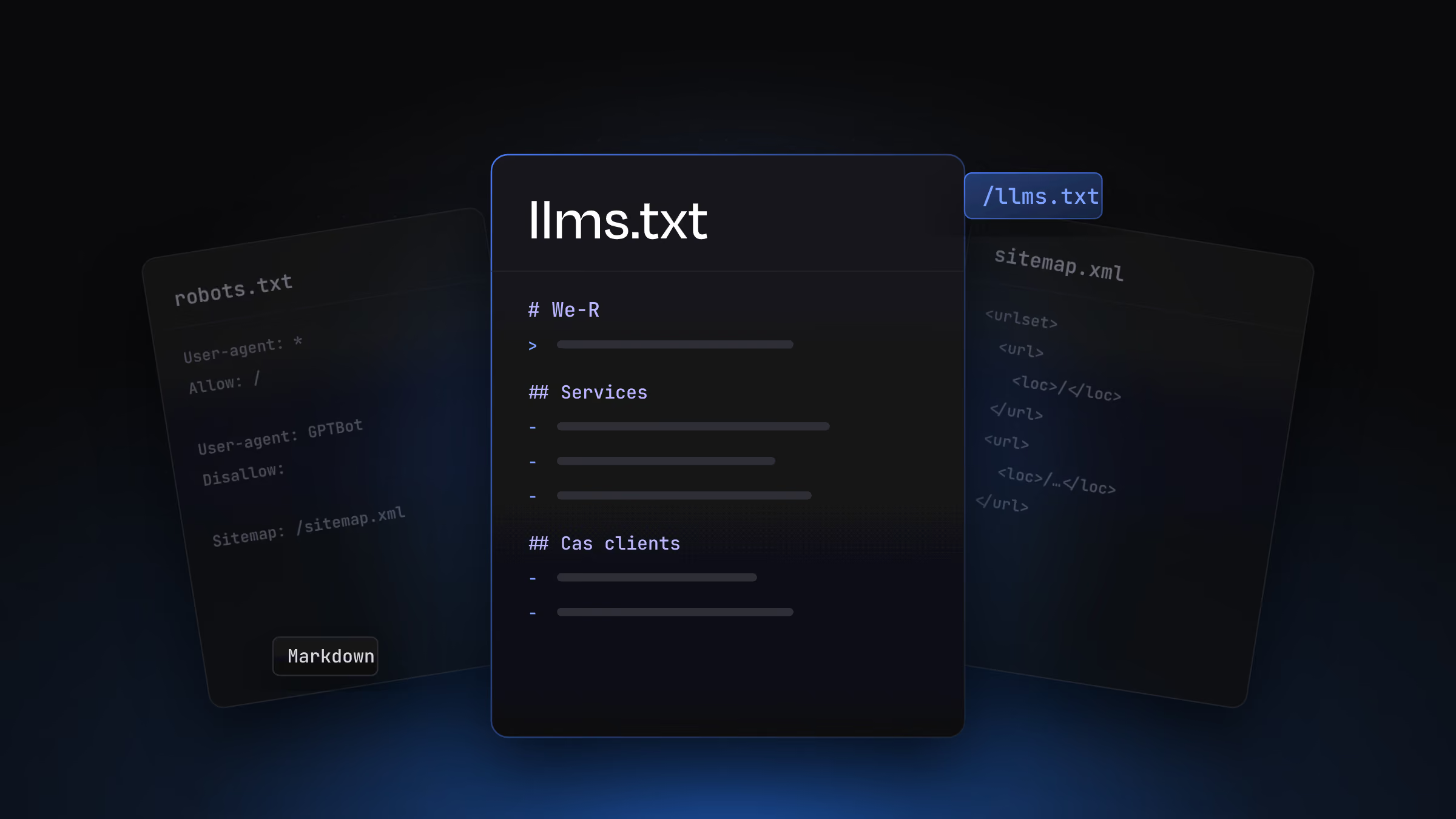
Content accessible in HTML, structured data, an llms.txt file, an official company information page, and logical internal linking. On Webflow, we build these foundations during the redesign and maintain them every week.
4. Mentions on the sources that AI consults
ChatGPT trusts what others say about you more than what you say about yourself. We identify the sources it actually uses in your market (comparison sites, directories, review platforms, media outlets) and then work on your brand's presence on the ones that matter.
5. Measurement linked to leads
We track a fixed panel of questions that prospects actually ask on ChatGPT, Perplexity, Gemini, and Google when comparing direct competitors. Each week, we monitor who is cited, which sources are used, and link traffic from AI models to actual contact requests.
| Workstream | What AI gains | At Linker |
|---|---|---|
| Positioning | Knowing who you are the right answer for | PR for tech startups and scale-ups |
| Pages that help buyers choose | Direct answers to buying questions | 13 industry pages, comparison pages, pillar page |
| Readable website | Reading and summarizing the site accurately | Structured data in FR + EN, llms.txt, official information page |
| External mentions | Third-party sources that confirm | Agency comparisons, Clutch, Sortlist, La Fabrique du Net |
| Measurement | Knowing what moves, week after week | 19 questions tracked against 11 competitors, leads tied to their channel |
The results at Linker
Linker is a Paris-based PR agency founded in 2022. After redesigning their site on Webflow, we launched an SEO & GEO campaign in January 2026 with a clear goal: to be recommended by AI when a tech startup looks for a PR agency.
Nine months later, for the period from September 14 to October 13, 2026 (Peec AI, 2,784 responses analyzed):
- Linker is the top agency cited by AI out of the 12 tracked, ahead of players established for 10 to 20 years;
- it appears in 66% of responses, and is the first result in 42% of them;
- its share of voice reached 31%, double that of its main competitor;
- after publishing a single agency comparison guide, its visibility in AI models jumped from 8.3% to 14.1% in two weeks.
In terms of business, SEO and AI have become their primary acquisition channel, accounting for 52% of their leads.
What made the difference for Linker wasn't the volume of articles. It was a sharp positioning, pages that help startup founders choose their agency, and a presence on the sources that AI consults. The details are in the Linker case study.
What doesn't work
Certain promises keep coming up. Here is our take on them:
- Paying to appear. There is no such thing as paid placement in ChatGPT's organic responses.
- The llms.txt file alone. Useful and inexpensive, but no major AI player has confirmed they use it to select their sources. It complements a clear website; it does not replace one.
- Keyword stuffing. AIs look for answers and evidence, not repetition.
- Guaranteeing a ranking. AI responses vary from one day to the next. An agency that guarantees "the top spot in ChatGPT" is selling you an isolated test, not a trend.
- Blocking AI bots. Blocking GPTBot prevents your content from being used for training, but blocking OpenAI's search crawlers also removes you from responses that cite their sources.
Where to start
Start by measuring. Ask ChatGPT the five questions a prospect would ask before contacting you, then note who is cited and which sources keep appearing. In twenty minutes, you will know if you have a problem and who your competitors are being recommended by.
As for what comes next, it is a months-long process that combines strategy, content, technical SEO, and authority. This is exactly what our SEO & GEO consulting covers: we start with an audit of your visibility on Google and within AI tools, then we tell you what is holding you back and where to begin.
Last updated: October 2026.
Sources: OpenAI, DevDay 2025 (800 million weekly users) · OpenAI, ChatGPT search documentation (third-party search engines) · Aggarwal et al., "GEO: Generative Engine Optimization," KDD 2024 · Peec AI, Linker data from 09/14 to 10/13/2026 · Linker client case study (We-R).
These businesses have migrated to Webflow
And their marketing teams thank us for it.