What is Claude Design?
Claude Design is Anthropic's visual creation tool, launched as a research preview in April 2026. It allows you to generate interactive visuals (models, slides, one-pagers, marketing pages) from a description in natural language.
Unlike Figma or Canva where you manipulate visual elements, here you write what you want. Claude generates HTML, CSS, and JavaScript live, displays an interactive preview, and allows iteration via chat, online comments, or adjustment sliders generated on the fly.
The tool integrates natively with Canva (direct export) and Claude Code (handoff to production), creating a closed loop idea → model → code in the Anthropic ecosystem.
Claude Design positions himself between “I have an idea” and “I can show my idea”, without needing to learn a design tool.
Key features
- Generating visuals from a prompt: UI mockups, pitch slides, marketing pages, social media templates.
- Chat iteration or direct editing: refine the result by instructions, online comments or adjustment sliders (spacing, colors, typography).
- Design system integration: Claude Design can read a codebase or design files to automatically apply existing tokens and components.
- Flexible export : PDF, shareable URLs, PPTX, or send directly to Canva for collaborative editing.
- Handoff to Claude Code: When the design is validated, a complete bundle is generated and sent to Claude Code in one instruction to move on to production.
- Canva graphics engine: exports benefit from Canva's rendering quality, directly editable in the Canva interface.
Claude Design is not a design tool. It is a visual communication tool. Nuance is key to understanding where it provides value.
For whom and in what contexts?
Claude Design is primarily aimed at people who need to make an idea visible quickly, without mastering a professional design tool.
It is particularly relevant in all contexts where the speed of communication takes precedence over the refinement of the final result.
- Founders, Product Managers, and Directors who want to illustrate an idea or direction before soliciting a design team.
- Non-designers who must present a concept to a client, an investor or internally without waiting for a service provider.
- Designers and creative teams who want to speed up the exploration phase before switching to Figma or Webflow for production.
Claude Design is very relevant to facilitate communication between a client and a designer: a visual generated in 5 minutes is better than a long text brief to align expectations.
Claude Design Prize
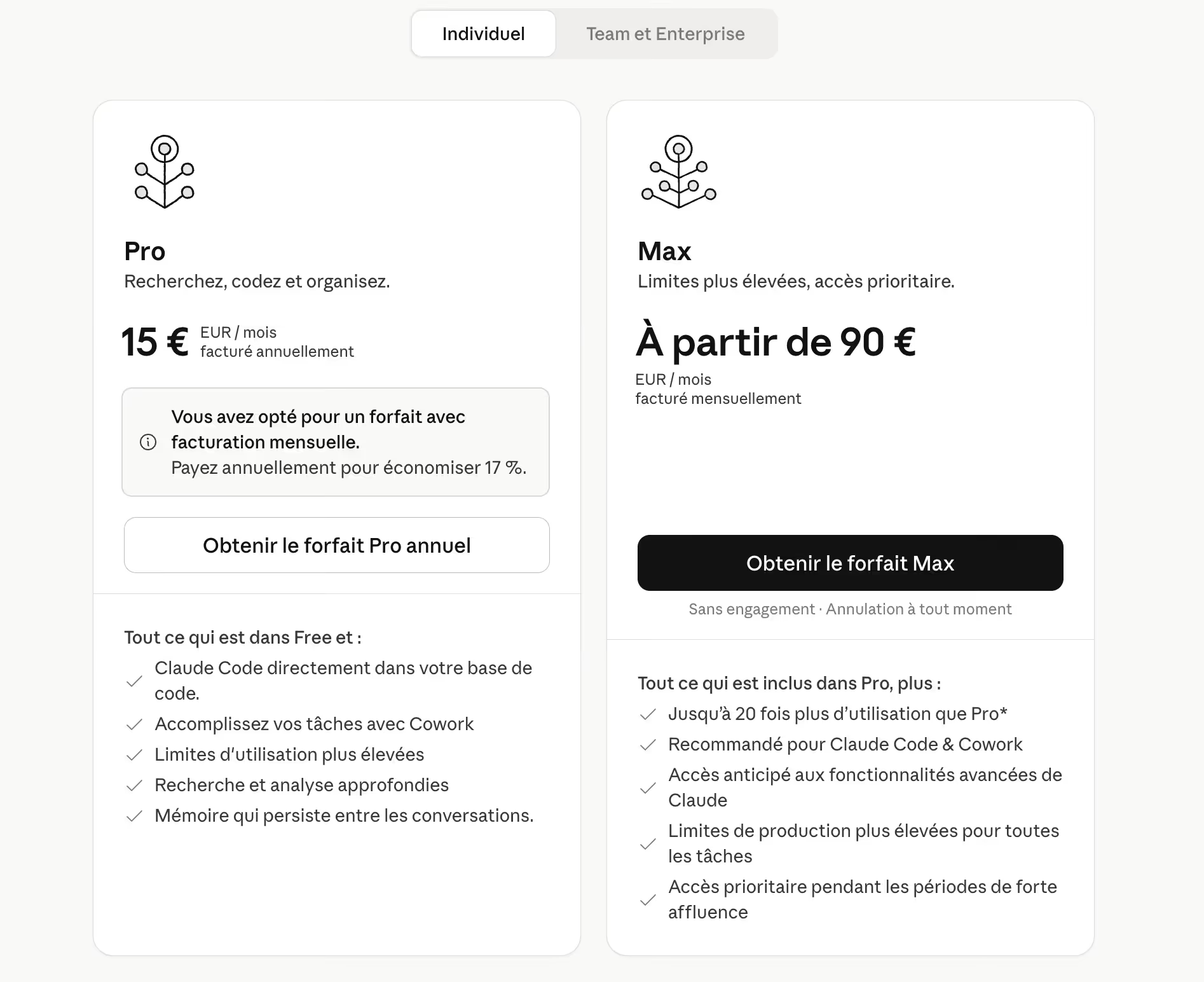
Claude Design is included in the Claude subscription. There is no separate pricing at this time. Access depends on the plan subscribed to on Claude.ai.
- Free plan: limited access to Claude Design with reduced quotas.
- Pro plan (€15/month): full access to Claude Design, priority on Opus 4.7 models and advanced use.
- Max plan (90€/month): higher limits and priority access.
- Team and Enterprise plans: activation required by the administrator, team access with centralized management.
For users already subscribed to Claude Pro, Claude Design does not represent any additional costs. That's a strong argument for trying it without friction.
We-R review on Claude Design
Claude Design is interesting, but you have to understand what it is and what it is not yet.
To illustrate an idea, to facilitate communication between a client and a designer, or to allow someone without design skills to produce a quick presentation, it is a real accelerator. For a single person or a non-designer, this is clearly a breakthrough.
But for a company with real brand, visual identity or large-scale production challenges, it cannot carry everything. AI must be managed by people who have the skills. A Claude Design managed by a designer, a Webflow MCP managed by a Webflow developer. AI supports, produces, accelerates. But under the control of those who know.
- Use Claude Design to quickly explore visual directions before briefing a designer.
- Generate a first visual to align customer and team with a direction, without waiting for a complete model.
- Accelerate the exploration and presentation phase for non-designer profiles within a team.
What is certain: these tools are progressing at a high speed. It would not surprise us that in 12 to 18 months, Claude Design will produce visuals that can be directly used in production for certain types of projects. The evolution should be monitored very closely.
Claude Design is already useful, but not to replace a designer. For now, it is the best tool to go from a fuzzy idea to a communicable visual in a few minutes.
Alternatives and tools similar to Claude Design
Two tools are positioned in nearby territories, with different approaches.
- Canva : the reference tool for non-designers, with a huge template library and an AI (Magic Studio) that is already mature, but we start from a template, not a prompt.
- v0 by Vercel : generates React/UI code from prompts, with a production-ready result, more oriented to developers than designers or non-designers.
- Figma : the professional reference for designers, no AI has yet replaced it for structured and collaborative production work at scale.
Compared to Canva, Claude Design stands out for the quick-first approach without a template, which is more powerful for exploration, less manageable for rigorous branding.